
Key Summary
Google Threat Intelligence Group (GTIG) has identified an AI-powered hacking framework capable of automating vulnerability research and exploit execution without human intervention. Named exploit_agent, the tool uses multiple AI agents to analyze software patches, identify potential vulnerabilities, and generate attack code. The discovery highlights growing concerns about autonomous cyberattacks, web shell threats, and the need for faster security detection and response.
Google Discovers Autonomous AI Hacking Tool
Google Threat Intelligence Group (GTIG) reported a significant development in AI-powered cyber threats on November 16, 2026.
According to its latest threat intelligence report, attackers have begun using large language model (LLM) frameworks to automate vulnerability discovery and exploitation without requiring human intervention during the execution process.
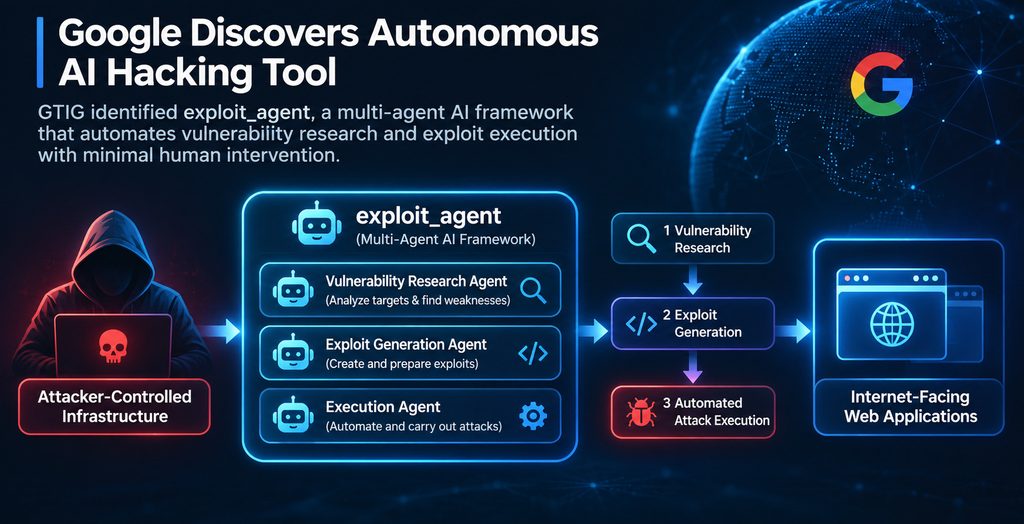
GTIG identified one such framework on an exposed attacker-controlled staging server.
The tool, named exploit_agent, was designed to coordinate multiple AI agents for vulnerability research and exploit development.
Unlike conventional hacking workflows that require an operator to perform individual tasks, exploit_agent can automate several stages of the attack process.
The framework integrates with multiple commercial and locally deployed LLMs. However, Google did not disclose the specific AI models involved.
The discovery represents an important development in the use of AI for offensive cybersecurity operations.
It demonstrates how attackers can combine AI models, automated analysis, and exploit-generation tools to reduce the amount of manual work required during an intrusion.
How AI Agents Automate the Attack Lifecycle
One of exploit_agent’s defining capabilities is its use of automated software analysis.
According to GTIG, the framework continuously examines commonly used web application software to identify potential security weaknesses.
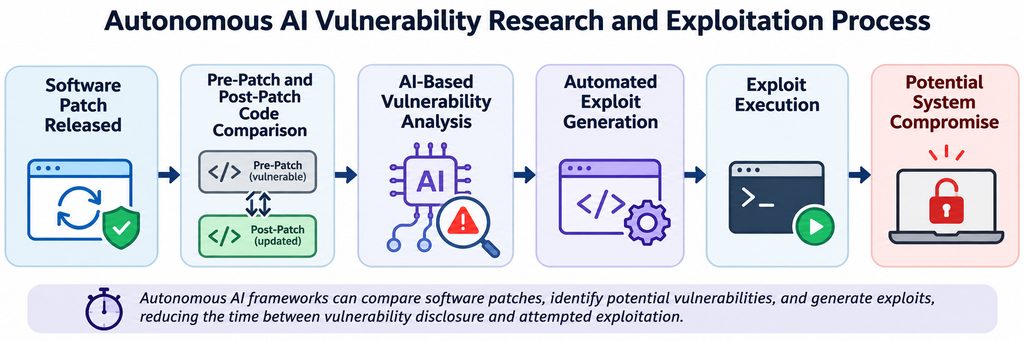
A key technique involves differential patch analysis.
This process compares software code before and after a security update to identify changes that may reveal previously vulnerable functionality.
Attackers can use these differences to investigate weaknesses in systems that have not yet been updated.
Exploit_agent combines this approach with LLM-based analysis.
The framework can examine code changes, identify potential vulnerabilities, generate exploit code, and execute the resulting attacks without additional human intervention.
This creates a largely automated vulnerability exploitation workflow.
The technique is particularly concerning for organizations operating internet-facing web applications.
Once a security patch becomes available, attackers may be able to analyze the changes and develop exploits before organizations complete their updates.
AI automation can therefore reduce the time available for defenders to identify and remediate vulnerable systems.
However, automated exploit generation does not guarantee successful exploitation.
AI-generated code may contain errors, and its effectiveness depends on the target environment and underlying vulnerability.
Evidence of Real-World Attacks and Web Shell Activity
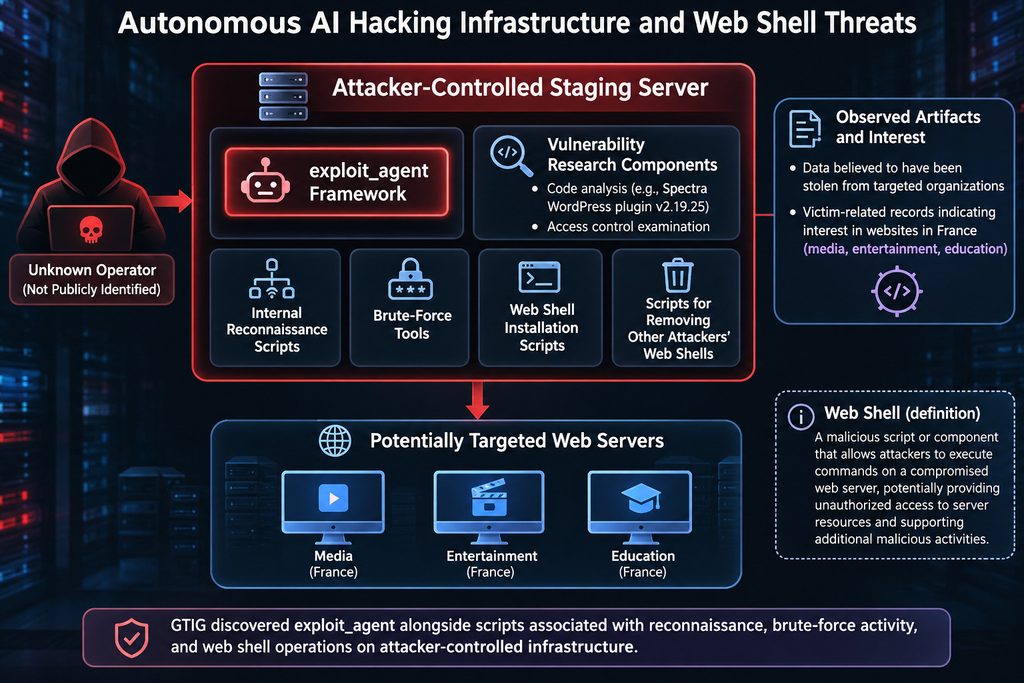
GTIG’s investigation revealed additional evidence of malicious activity associated with the attacker-controlled staging server.
Researchers identified data believed to have been stolen from targeted organizations.
They also discovered scripts designed to support several post-compromise activities.
These included internal network reconnaissance, brute-force attacks, web shell installation, and the removal of web shells belonging to other attackers.
A web shell is a malicious script or component that allows attackers to execute commands on a compromised web server.
Once deployed, a web shell may provide unauthorized access to server resources and support additional malicious activities.
The presence of web shell-related scripts is particularly relevant to organizations operating public-facing web infrastructure.
According to GTIG, victim-related records on the staging server suggested that the operator was interested in websites associated with the media, entertainment, and education sectors in France.
The investigation also identified code analysis involving version 2.19.25 of Spectra, a WordPress plugin.
The framework examined access control implementations within the plugin as part of its vulnerability research activity.
These findings provide insight into how AI-assisted vulnerability analysis may be combined with conventional post-compromise techniques.
However, the presence of malicious scripts on the server does not establish that exploit_agent independently executed every observed activity.
GTIG also did not publicly identify the operator responsible for the infrastructure.
Zero-Day Exploitation and Emerging AI Attack Frameworks
Google’s findings also highlight broader developments in AI-assisted vulnerability exploitation.
According to GTIG, the monthly average number of observed zero-day exploitation cases increased from eight in 2025 to eleven in 2026.
The figure reached 22 in August 2026.
These findings suggest growing exploitation activity, although the increase cannot be attributed entirely to AI.
GTIG also discussed attacks involving vulnerabilities in PaperCut print management software.
Two vulnerabilities were identified:
- CVE-2026-81578: An authentication bypass vulnerability.
- CVE-2026-82078: An unsafe dynamic class-loading vulnerability.
According to Google’s report, attackers exploited these vulnerabilities as zero-days in late August 2026.
Security researchers, including Huntress, subsequently demonstrated that LLMs could help reproduce working exploits within a day of disclosure.
This illustrates how AI tools can accelerate the development of attack code for newly disclosed vulnerabilities.
Beyond exploit_agent, GTIG identified several AI-enabled offensive security frameworks being used or evaluated by threat actors.
These included ARTEX, CAIRN, CyberStrikeAI, HexStrike AI, and PentAGI.
Some frameworks coordinate multiple AI agents, while others connect LLMs to existing security tools and automated workflows.
Although their architectures differ, these technologies demonstrate how AI can accelerate reconnaissance, vulnerability research, and exploitation.
The growing availability of such frameworks may lower the technical barriers required to conduct complex cyber operations.
At the same time, Google noted that autonomous tools can leave recognizable network activity and code-level traces, creating opportunities for defenders to detect their use.
Why Autonomous AI Attacks Challenge Web Security
The emergence of autonomous AI hacking tools presents new challenges for organizations responsible for protecting web applications and servers.
Many existing attacks still rely on familiar weaknesses, including unpatched software, compromised credentials, and insecure configurations.
What changes with AI automation is the speed at which attackers may identify and exploit these weaknesses.
Automated frameworks can continuously analyze software updates and investigate exposed systems.
This may shorten the time available for organizations to apply patches and strengthen vulnerable services.
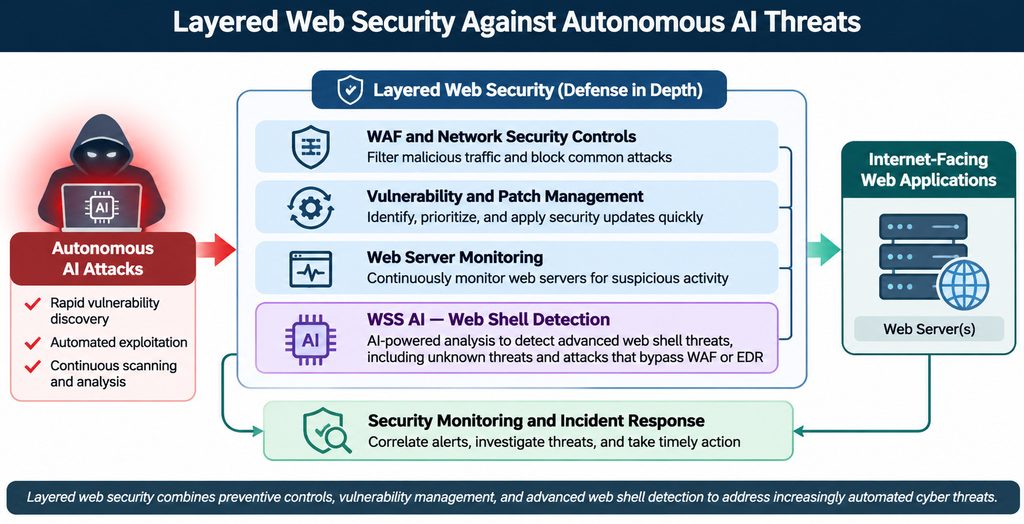
Traditional security controls, including Web Application Firewalls (WAF) and Endpoint Detection and Response (EDR) solutions, remain important.
However, sophisticated attacks may bypass individual security layers.
Organizations therefore need complementary technologies that can identify malicious activity targeting web servers.
Web shell detection is particularly relevant because compromised web servers may be used to execute unauthorized commands or maintain attacker access.
UMV’s WSS AI uses AI-powered analysis to detect advanced web shell threats, including previously unknown threats and attacks that bypass conventional WAF or EDR defenses.
By complementing existing security controls, WSS AI can help organizations strengthen their ability to identify malicious web shell activity.
This capability is relevant to the broader risks highlighted by Google’s findings.
However, the GTIG report does not establish that WSS AI was tested against exploit_agent or the specific attacks described in the investigation.
Strengthening Detection and Cyber Resilience
As autonomous AI attack tools continue to evolve, organizations need security strategies that address both prevention and recovery.
The first priority is maintaining visibility into internet-facing systems.
Organizations should maintain an accurate inventory of web applications, servers, plugins, and externally accessible services.
Security teams should also monitor newly disclosed vulnerabilities and prioritize patches for exposed systems.
Because AI-assisted patch analysis may accelerate exploit development, delays in applying security updates can increase operational risk.
Access controls, credential management, and server monitoring remain essential.
Organizations should investigate suspicious server activity and look for indicators of unauthorized command execution or web shell installation.
In addition to detecting threats, businesses must prepare for incidents that affect website integrity and service availability.
This is where cyber resilience becomes important.
Cyber resilience emphasizes the ability to maintain operations and recover quickly when security incidents occur.
UMV’s WARSS supports website integrity monitoring and recovery from unauthorized modifications.
By detecting website defacement and restoring affected content, WARSS can help reduce disruption associated with website integrity incidents.
WSS AI and WARSS address complementary aspects of web security.
WSS AI focuses on advanced web shell detection, while WARSS supports website integrity and recovery.
Neither solution replaces secure software development, vulnerability management, or comprehensive incident response planning.
Google’s discovery of exploit_agent demonstrates how AI is becoming increasingly integrated into offensive cybersecurity operations.
Although autonomous frameworks may still produce errors and leave detectable traces, their ability to accelerate attack workflows creates new challenges for defenders.
Organizations must therefore strengthen their ability to identify vulnerabilities, detect malicious activity, and recover from security incidents.As cyberattacks become increasingly automated, effective web security will depend on combining preventive defenses with advanced detection and recovery capabilities.
Related Threat Intelligence
- AI-Powered Hacking Exposes Web Server Security Gaps in Korea and Japan
- Windows Web Server Attacks in Q3 2026: Web Shells and Vulnerability Exploitation
- OpenAI AI Autonomous Cyberattack
- Web Shells Remain the Primary Entry Point in Windows Web Server Attacks
- Active Exploitation Highlights the Growing Risk of Web Shell-Based Attacks Against Enterprise Applications
- New Linux Vulnerability Possibly Exploited in Attacks
- Suspected North Korean Hackers Linked to Large-Scale Golf Club Data Breach
- GitHub CVE-2026-3854 Enables Remote Code Execution via Single Git Push
- Ivanti EPMM Vulnerability Exploited to Deploy Sleeper Webshells
- Linux Security Alert: Cookie PHP Web Shells (MS Report)
- Dell WMS Vulnerability: Defending Against JSP Webshells
- ASP.NET Web Shell Threats Targeting IIS Servers (UAT-8099 Case Study)
- BeyondTrust Flaw Used for Web Shells, Backdoors, and Data Exfiltration
- Web Shells and Lateral Movement
- Godzilla Webshell: A Growing Cybersecurity Threat to Healthcare
- The Evolution of the China Chopper
- APT41’s Cyber Espionage Campaign: Web Shells at the Core of Network Infiltration
Sources
News: Google Identifies AI Tool Capable of Hacking Without Human Intervention for the First Time