
Key Summary
Recent data breaches in South Korea and Japan have exposed security weaknesses in overlooked web services, backend systems, and third-party platforms. Security investigations also highlight how AI-powered tools can accelerate vulnerability discovery and potentially automate web shell attacks. These developments reinforce the need for stronger access controls, web server monitoring, and layered security defenses.
Overlooked Web Services Become Entry Points for Cyberattacks
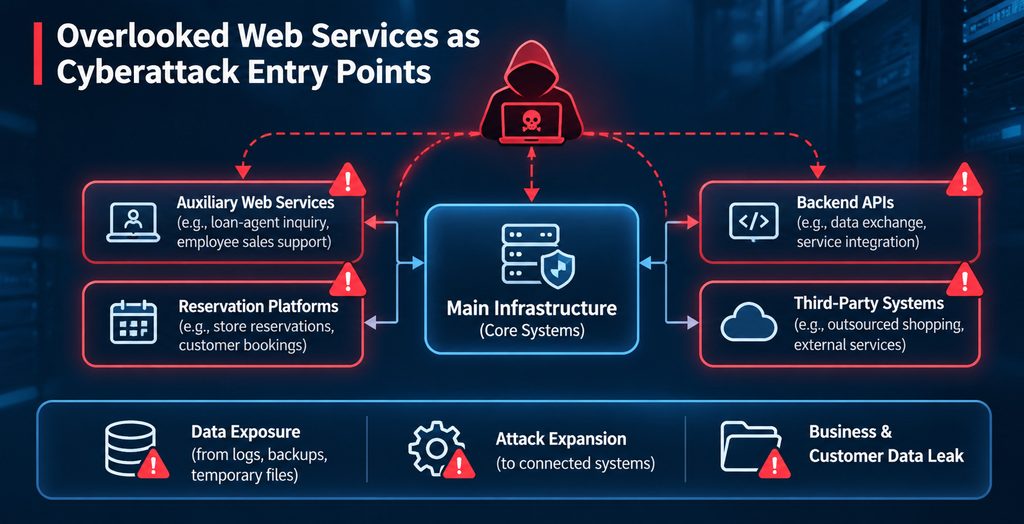
Recent cybersecurity incidents in South Korea and Japan have revealed a common security concern: attackers are increasingly targeting systems outside an organization’s primary infrastructure.
According to a November 7, 2026, report by Yonhap News, several data breaches involved publicly accessible services connected to larger business systems.
In South Korea, reported incidents involved supplementary financial services, including loan-agent inquiry systems and employee sales support platforms.
Rather than targeting core banking infrastructure directly, attackers exploited weaknesses in auxiliary systems connected to financial operations.
Similar risks appeared in Japan.
One reported incident involved a department store reservation website that provided a route toward customer management systems. Other cases involved outsourced shopping platforms and customer inquiry services.
These incidents demonstrate how smaller, less-protected services can become entry points into sensitive business environments.
Data retention also contributed to the risks.
In one Korean case, temporary files created during an earlier service update remained in cloud storage. In Japan, customer information stored in system logs was also exposed during a separate incident.
The findings highlight the importance of securing all connected services, including systems that organizations may no longer actively use.
AI-Assisted Attacks Target Backend APIs
Mobile applications often communicate with backend servers to process authentication, retrieve user information, and manage business operations.
These connections rely on Application Programming Interfaces (APIs).
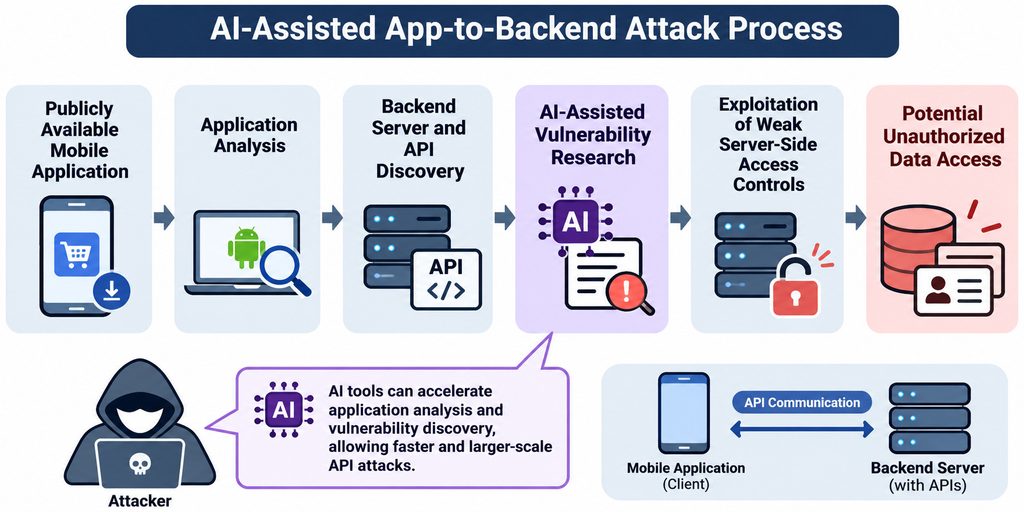
Japan’s National Institute of Information and Communications Technology (NICT) has examined an attack approach known as App-to-Backend (A2B).
In this approach, attackers analyze publicly available mobile applications to identify their backend servers and communication methods.
The attackers can then investigate exposed APIs and search for weaknesses in server-side security controls.
Importantly, the mobile application itself does not necessarily need to contain a vulnerability.
If a backend server fails to verify user identities or access permissions correctly, attackers may be able to retrieve information they should not be authorized to access.
AI tools can make this process more efficient by accelerating application analysis and vulnerability discovery.
The Japan Computer Emergency Response Team Coordination Center (JPCERT/CC) also identified real-world activity involving AI-assisted vulnerability research and API attacks.
Investigators discovered Android application packages, application analysis tools, and evidence of attempts to identify vulnerable APIs on attacker-controlled systems.
The findings suggest that AI-assisted reconnaissance can increase the speed and scale of attacks against internet-facing services.
ARTEX Demonstrates Automated Web Shell Attacks
Another significant finding involves ARTEX, an AI-powered automated penetration testing tool.
According to AhnLab Security Intelligence Center (ASEC), ARTEX-related indicators were identified during investigations involving cyberattacks in South Korea and Japan.
In South Korea, security researchers discovered ARTEX-related strings on a web server associated with a financial-sector incident.
In Japan, cybersecurity company GMO Cybersecurity by Ierae reported identifying ARTEX within infrastructure associated with an attack against a Japanese organization.
However, investigators have not established that the incidents were conducted by the same attacker.
The extent of ARTEX’s involvement in the Korean financial-sector incident also remains under investigation.
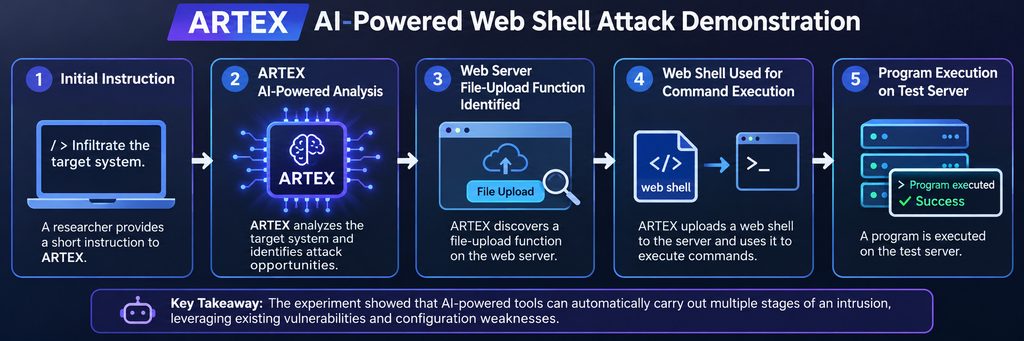
To better understand the tool’s capabilities, AhnLab researchers recreated ARTEX in a separate controlled testing environment.
The researchers provided a short instruction directing the tool to infiltrate a target system.
ARTEX then identified a file-upload function on the web server.
Without additional human intervention, it proceeded to use a web shell to execute a program on the server.
A web shell is a malicious script or component that allows attackers to execute commands on a compromised web server.
This experiment demonstrated how AI-powered tools can automate multiple stages of an intrusion that would otherwise require manual investigation and execution.
The underlying techniques were not necessarily new.
Instead, the experiment illustrated how automation could make existing vulnerabilities and configuration weaknesses easier to exploit.
Why Traditional Security Measures Are Not Enough
The reported incidents demonstrate that organizations cannot rely exclusively on protecting their primary applications and infrastructure.
Auxiliary services, backend APIs, outsourced platforms, and forgotten files can create additional security risks.
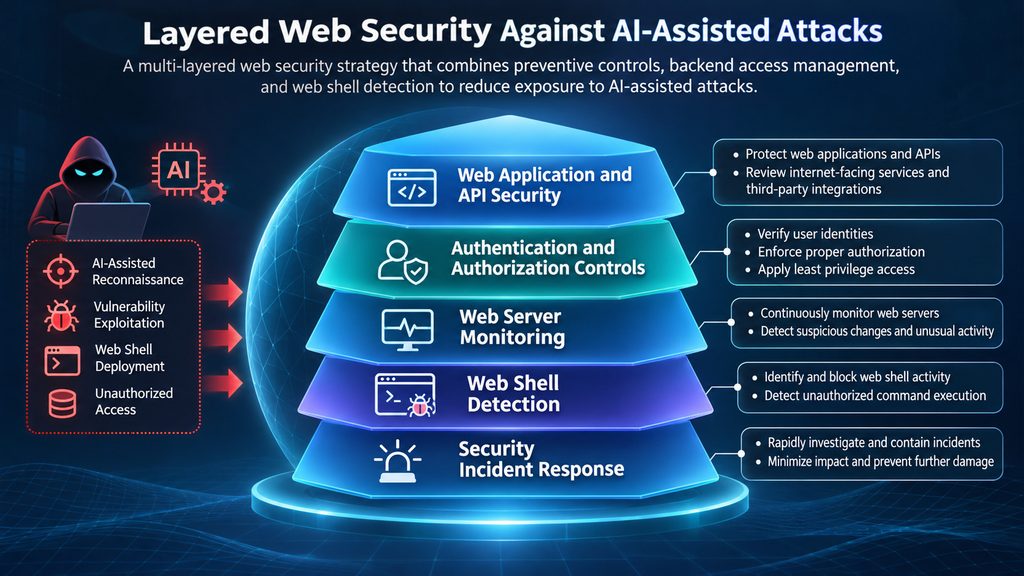
Traditional preventive controls remain important, but they must be supported by effective access management and continuous monitoring.
Organizations should verify that backend systems properly authenticate users and enforce authorization checks for every sensitive operation.
Security teams should also review internet-facing services, API endpoints, and third-party integrations.
However, access control weaknesses are only one part of the problem.
The ARTEX experiment also highlights the continued relevance of web shell threats.
If attackers successfully exploit a vulnerable web server, a web shell may provide a mechanism for executing unauthorized commands.
This makes web shell detection an important component of a layered web security strategy.
AI-assisted attack tools may accelerate the discovery and exploitation of weaknesses, increasing the importance of identifying malicious activity before it causes further damage.
Strengthening Web Security Against AI-Driven Threats
The investigations emphasize several practical measures organizations can adopt to strengthen their security posture.
First, organizations should maintain an accurate inventory of publicly accessible web services, APIs, and administrative interfaces.
This inventory should include supplementary systems and services operated by external vendors.
Second, backend systems must independently verify user identities and access permissions.
Security should not depend solely on checks performed within a mobile application.
Third, organizations should avoid embedding long-lived credentials or sensitive API secrets in publicly distributed applications.
Unused credentials should be revoked or replaced, while unnecessary services and API endpoints should be disabled.
Fourth, security teams should monitor abnormal requests and investigate signs of unauthorized access.
Finally, organizations should remove unnecessary stored information, including outdated temporary files and sensitive data retained in logs.
Beyond these preventive measures, web shell detection provides an additional layer of protection.
UMV’s WSS AI uses AI-powered analysis to detect advanced web shell threats, including previously unknown threats and attacks that bypass conventional WAF or EDR defenses.
This capability can complement existing security controls by helping organizations identify malicious activity targeting web servers.
However, web shell detection does not replace proper API authorization, vulnerability management, or data protection practices.An effective security strategy requires these measures to work together.
Building Cyber Resilience Against Evolving Cyber Threats
As AI-assisted attacks become more capable, organizations must prepare for situations in which preventive security controls fail.
Cyber resilience focuses on maintaining business operations and recovering from security incidents with minimal disruption.
For web infrastructure, this includes detecting unauthorized modifications and restoring affected website content.
UMV’s WARSS supports this approach through website integrity monitoring and recovery capabilities.
WARSS is designed to identify unauthorized website modifications and support rapid restoration of affected content.
These capabilities can help organizations reduce disruption from website integrity incidents.
WSS AI and WARSS therefore address complementary aspects of web security.
WSS AI focuses on identifying advanced web shell threats, while WARSS supports recovery from unauthorized website modifications.
Neither capability should be viewed as a substitute for secure application development, API access controls, or broader incident response planning.
The incidents reported in South Korea and Japan reinforce the importance of securing every exposed connection to business systems.
As AI-powered attack tools continue to evolve, organizations need to combine preventive security, advanced threat detection, and recovery preparedness.Protecting core infrastructure alone is no longer sufficient when overlooked services can expose sensitive information.
Related Threat Intelligence
- Windows Web Server Attacks in Q3 2026: Web Shells and Vulnerability Exploitation
- OpenAI AI Autonomous Cyberattack
- Web Shells Remain the Primary Entry Point in Windows Web Server Attacks
- Active Exploitation Highlights the Growing Risk of Web Shell-Based Attacks Against Enterprise Applications
- New Linux Vulnerability Possibly Exploited in Attacks
- Suspected North Korean Hackers Linked to Large-Scale Golf Club Data Breach
- GitHub CVE-2026-3854 Enables Remote Code Execution via Single Git Push
- Ivanti EPMM Vulnerability Exploited to Deploy Sleeper Webshells
- Linux Security Alert: Cookie PHP Web Shells (MS Report)
- Dell WMS Vulnerability: Defending Against JSP Webshells
- ASP.NET Web Shell Threats Targeting IIS Servers (UAT-8099 Case Study)
- BeyondTrust Flaw Used for Web Shells, Backdoors, and Data Exfiltration
- Web Shells and Lateral Movement
- Godzilla Webshell: A Growing Cybersecurity Threat to Healthcare
- The Evolution of the China Chopper
- APT41’s Cyber Espionage Campaign: Web Shells at the Core of Network Infiltration
Sources
News: [AI Spotlight] South Korea and Japan Hit by Cyberattacks: Small Vulnerabilities Lead to Customer Data Leaks