



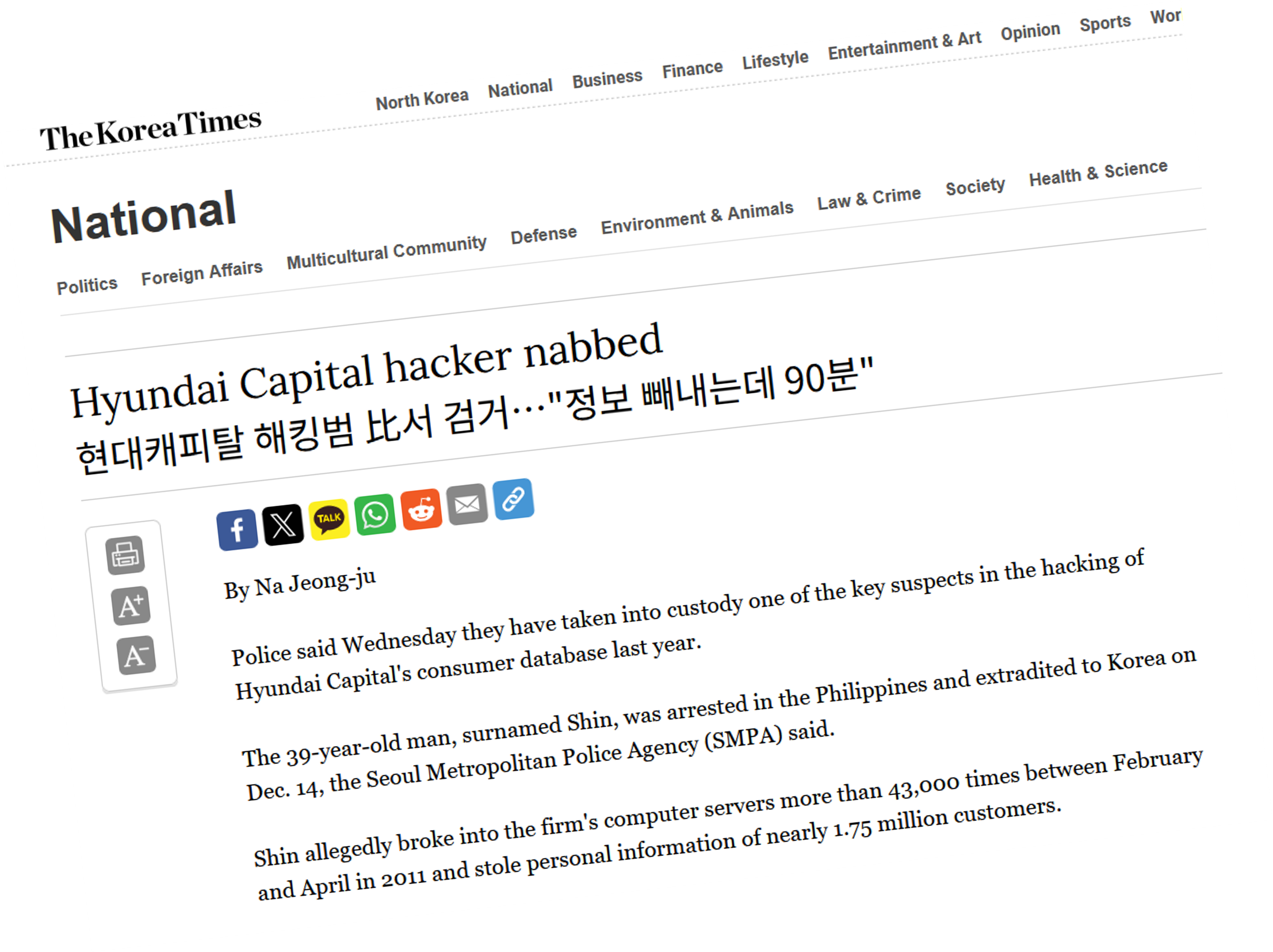
The 39-year-old man, surnamed Shin, was arrested in the Philippines and extradited to Korea on Dec. 14, the Seoul Metropolitan Police Agency (SMPA) said.
April 2011 Hack
420,000 customers’ (~24%) personal information leaked in breach (~2 months) by unidentified hacker
Damages
~$100,000 USD lost directly to hacker; 13,000 clients’ passwords stolen
Implementation Details
WSS was integrated into Hyundai Capital’s on-premise and hybrid cloud infrastructure. The deployment focused on securing critical web servers against web shells, malicious scripts, and unauthorized modifications.
Key Initiatives
Hyundai Capital’s internal security team reported increased confidence in their web server protection, stating that WSS significantly reduced manual workload and improved detection speed. The solution’s lightweight architecture and real-time response capabilities were particularly appreciated, contributing to enhanced operational stability and customer trust.
AI Cybersecurity AI Security AI Web Security apt Artificial Intelligence ASEC Backdoor case study Central Asia CISA KEV Cloud Security CVE-2026-1281 Cyber Resilience Cybersecurity data breach data exfiltration Dirty Frag enterprise security Financial Security hack Korea Leading Company Award Kubernetes Security Machine Learning Microsoft Security North Korean Hackers Ransomware Attack Remote Code Execution Security Software Threat Detection Threat Intelligence UMV WAF WARSS Web Security Web Server Security web shell web shell detection web shells Website Integrity wss zero-day zero-day exploitation Zero Trust zyon zyon ai