
Key Summary
Windows web servers remain attractive targets for attackers exploiting unpatched vulnerabilities and insecure configurations. ASEC’s Q3 2026 report highlights attacks involving remote code execution, privilege escalation, and web shell deployment. The findings underscore the importance of vulnerability management, web shell detection, and continuous web server monitoring.
Windows Web Servers Face Multiple Attack Methods
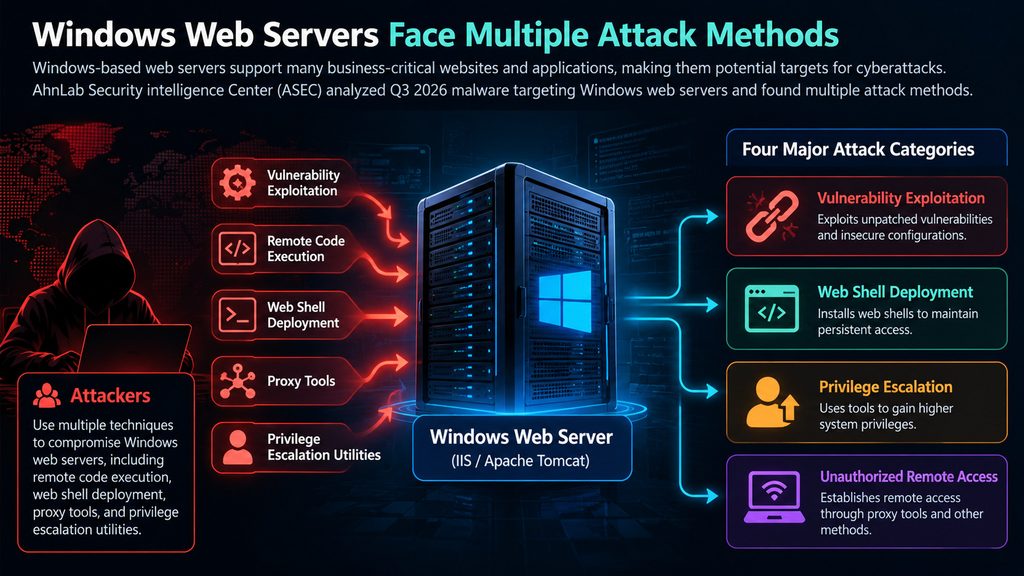
Windows-based web servers support many business-critical websites and applications. Their internet-facing nature also makes them potential targets for cyberattacks.
On October 8, 2026, AhnLab SEcurity intelligence Center (ASEC) published its Q3 2026 analysis of malware targeting Windows web servers.
The research examined security logs collected through AhnLab Smart Defense (ASD). It focused on Microsoft Internet Information Services (IIS) and Apache Tomcat servers operating in Windows environments.
ASEC identified several conditions associated with server compromise, including unpatched vulnerabilities, insecure configurations, and insufficient system management.
Attackers used multiple techniques to compromise these systems. These included remote code execution, web shell deployment, proxy tools, and privilege escalation utilities.
CVE-2019-18935: Exploiting a Vulnerable Web Framework
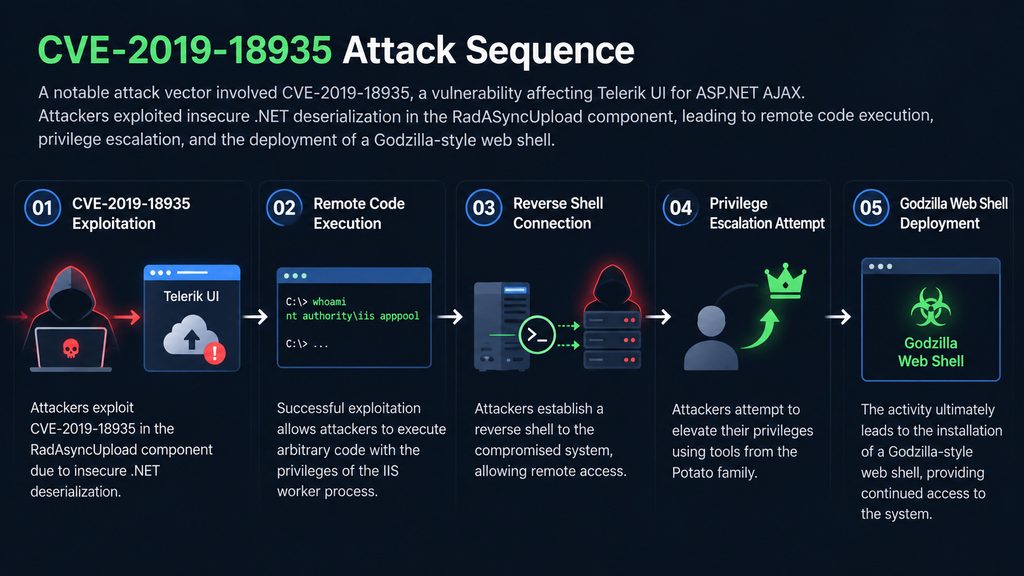
One notable attack vector involved CVE-2019-18935, a vulnerability affecting Telerik UI for ASP.NET AJAX.
The vulnerability involves insecure .NET deserialization within the RadAsyncUpload component.
Successful exploitation can allow attackers to execute code with the privileges of the IIS worker process.
ASEC described two attacks observed in South Korea that involved this vulnerability.
In the first case, attackers exploited the vulnerability and established a reverse shell. They then gathered information about the compromised system.
The attackers also attempted to elevate their privileges using tools from the Potato family.
Their activity ultimately led to the installation of a Godzilla-style web shell.
The case illustrates how an unpatched web application component can become an entry point for broader server compromise.
Web Shells Enable Continued Access to Compromised Servers
A web shell is a malicious script or component that allows attackers to interact with a compromised web server.
Depending on its capabilities, a web shell may enable remote command execution and other unauthorized activities.
In ASEC’s first attack case, the attackers deployed a memory-based web shell associated with the Godzilla framework.
The malicious component operated within the ASP.NET environment. It enabled the execution of additional .NET payloads through specially crafted HTTP requests.
This technique demonstrates why web shell threats cannot be understood solely as suspicious files stored on disk.
Some attacks involve malicious components loaded into memory or integrated with legitimate application functionality.
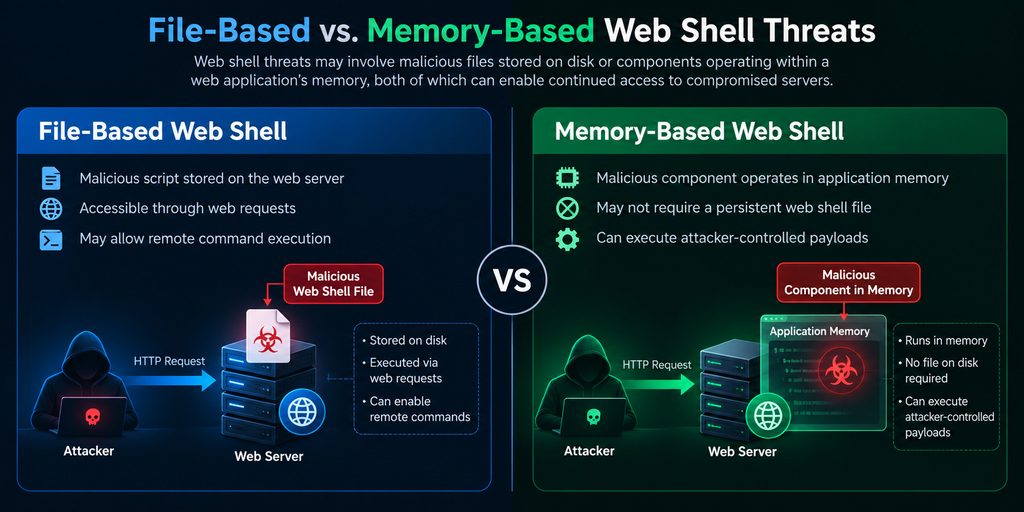
Security teams therefore need to consider both file-based threats and suspicious server behavior when investigating possible compromise.
Compromised Web Servers Can Support Additional Attacks
ASEC’s second case showed a different outcome following exploitation of CVE-2019-18935.
Rather than installing a web shell, the attacker executed a scanner developed in Rust.
The scanner examined websites for WordPress installation and configuration pages. It checked multiple possible paths and reported identified targets through Telegram.
This activity illustrates how a compromised server can become a resource for further reconnaissance.
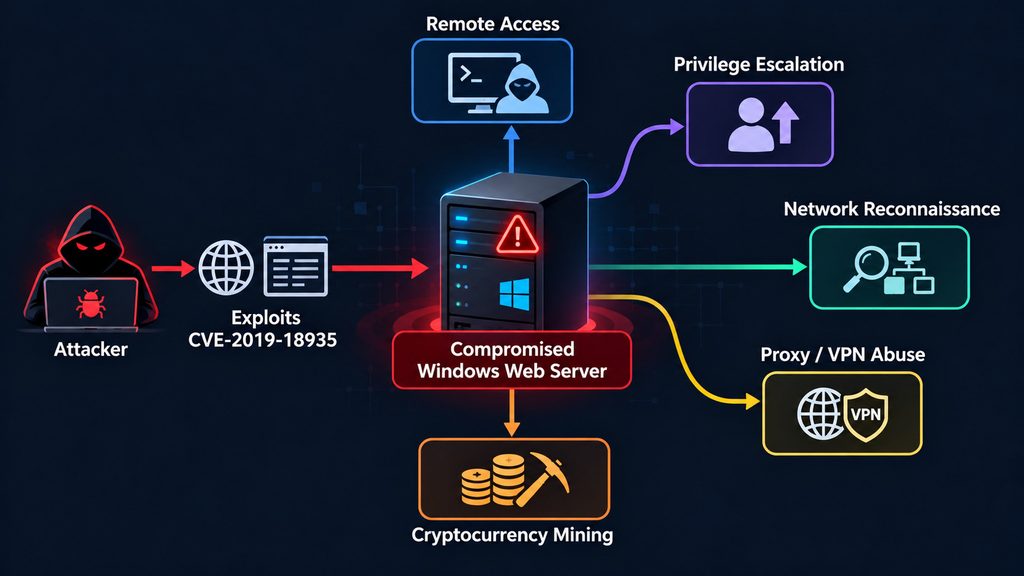
ASEC also identified broader post-compromise activities associated with attacks against Windows web servers.
These included privilege escalation, remote control, proxy exploitation, cryptocurrency mining, and the use of compromised servers as VPN infrastructure.
Strengthening Windows Web Server Security
The ASEC findings highlight the importance of addressing vulnerabilities before attackers can exploit them.
Organizations should regularly update web frameworks, application components, and server software.
Internet-facing services should also be reviewed to reduce unnecessary exposure.
Firewalls and access controls can help limit unauthorized connections to sensitive services.
Security teams should monitor for suspicious processes, unexpected file changes, and unusual web application behavior.
Web shell detection is particularly important because attackers may attempt to maintain access after the initial vulnerability has been exploited.Effective defense requires more than a single security control. Vulnerability management, access restrictions, malware detection, and incident response should work together.es that future AI-driven attacks may become increasingly resilient even when individual execution environments are destroyed.
Why Continuous Web Server Monitoring Matters
The Q3 2026 findings demonstrate how a single vulnerable web application component can expose an entire server to additional threats.
Attackers may begin with remote code execution and then attempt privilege escalation or persistent access.
In other cases, they may use compromised infrastructure to scan additional targets.
These different outcomes reinforce the need for continuous visibility into web server security.
Organizations should prioritize timely patching, proactive threat detection, and investigation of suspicious activity.By strengthening these practices, security teams can reduce the likelihood of compromise and limit the impact of successful attacks.
Related Threat Intelligence
- OpenAI AI Autonomous Cyberattack
- Web Shells Remain the Primary Entry Point in Windows Web Server Attacks
- Active Exploitation Highlights the Growing Risk of Web Shell-Based Attacks Against Enterprise Applications
- New Linux Vulnerability Possibly Exploited in Attacks
- Suspected North Korean Hackers Linked to Large-Scale Golf Club Data Breach
- GitHub CVE-2026-3854 Enables Remote Code Execution via Single Git Push
- Ivanti EPMM Vulnerability Exploited to Deploy Sleeper Webshells
- Linux Security Alert: Cookie PHP Web Shells (MS Report)
- Dell WMS Vulnerability: Defending Against JSP Webshells
- ASP.NET Web Shell Threats Targeting IIS Servers (UAT-8099 Case Study)
- BeyondTrust Flaw Used for Web Shells, Backdoors, and Data Exfiltration
- Web Shells and Lateral Movement
- Godzilla Webshell: A Growing Cybersecurity Threat to Healthcare
- The Evolution of the China Chopper
- APT41’s Cyber Espionage Campaign: Web Shells at the Core of Network Infiltration
Sources
News: Q3 2026 Statistical Report on Malware Targeting Windows Web Servers